


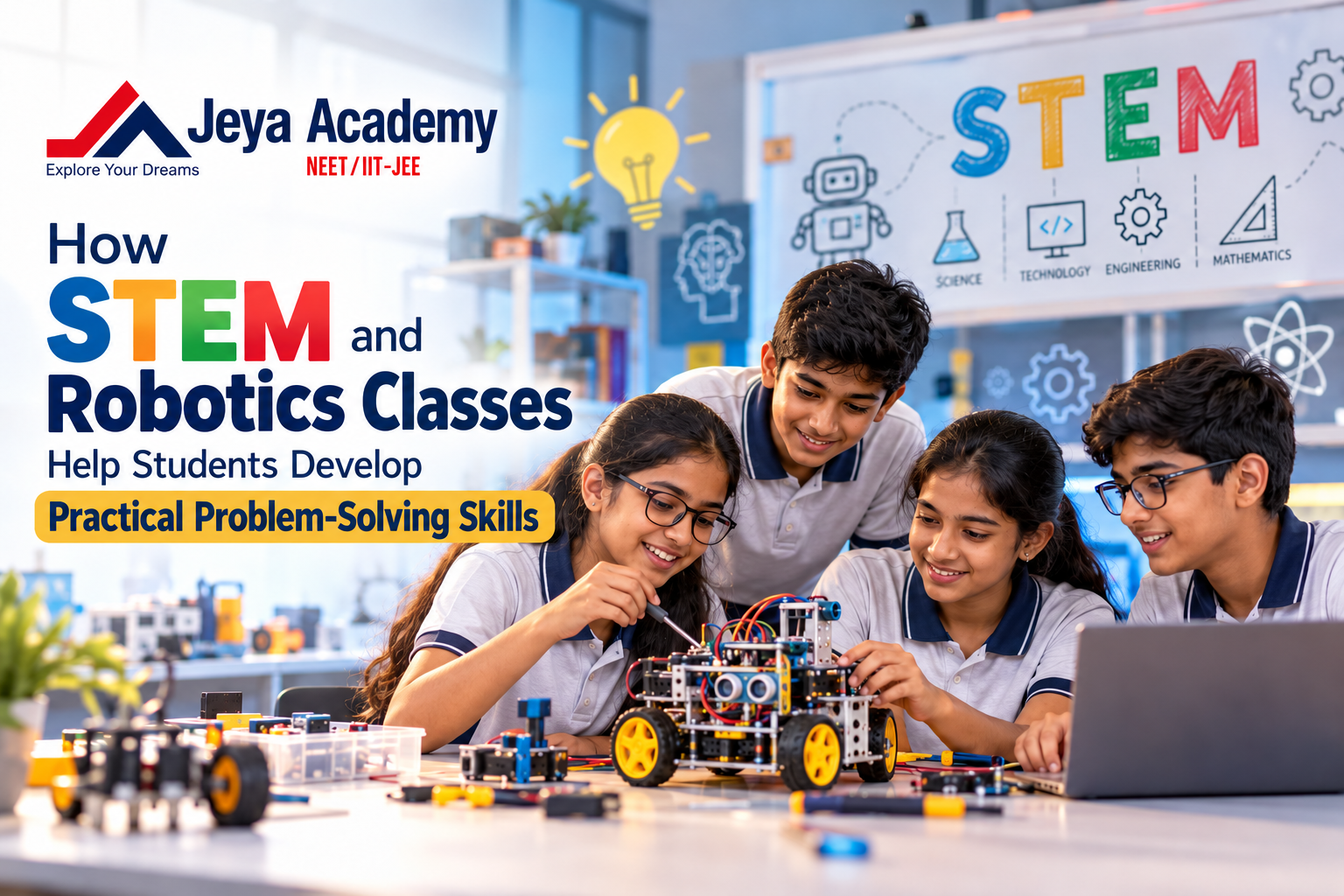
How STEM and Robotics Classes Help Students Solve Real Problems
Students learn best when they use what they know in real life. Formulas and theories matter. However, hands-on practice builds confidence and creativity. It also teaches students to think on their own.
That is why STEM and Robotics classes in Tuticorin are becoming popular. Parents want their children to learn more than textbooks can teach.
What Are STEM and Robotics Classes?
STEM stands for science, technology, engineering, and mathematics. These four subjects are taught together. Students learn through activities, experiments, and projects. As a result, they gain useful skills and learn to solve problems.
Robotics teaches students to design, build, and program machines. Each machine performs a specific task. Together, STEM and robotics help children try out ideas. They test solutions and see how technology works.
For example, a student can use a sensor to build a robot that detects obstacles. In this way, theory becomes real learning.
1. Encourages Logical Thinking and Problem-Solving
Every robotics project starts with a challenge. First, students understand the problem. Then they look for solutions and plan the steps.
For example, a robot that follows a path needs movement, direction, sensors, and code. Students must think about all of these together.
As a result, they learn to think logically. They also learn to solve hard problems step by step.
2. Develops Creativity Through Practical Experiments
STEM encourages students to think beyond one fixed answer.
When they design a robot, they can try different materials, shapes, and programs. Moreover, each student can solve the same challenge in a different way.
Trying these options builds creativity. It also helps students find new and better ideas.
3. Teaches Students to Learn From Mistakes
Robotics experiments rarely work on the first try.
For instance, a robot may turn the wrong way or miss an object. It may even stop without warning. In that case, students find the cause, fix it, and test again.
This teaches a key lesson: mistakes help us improve.
Because they repeat this cycle, students gain patience. They also feel more confident when tasks get hard.
4. Improves Teamwork and Communication
Many STEM activities are group projects. Students work together toward one goal.
Each member may take a role, such as designing, coding, building, or testing. Therefore, everyone has something to contribute.
Through this process, students learn to share ideas clearly. They also learn to listen to others and solve problems as a team.
5. Connects Classroom Subjects With Real-World Applications
Students often ask why they need maths and science. Robotics gives clear answers.
For example, maths helps measure movement and distance. Science explains circuits and sensors. Engineering guides how a machine is built.
Because of this, STEM and Robotics classes in Tuticorin show students how subjects connect. They also show how these subjects solve daily problems.
6. Builds Confidence and Independent Thinking
Finishing a working robot feels great. Each small success adds to a student's confidence.
Students handle every step, from choosing parts to fixing code errors. As they practise, they learn to make decisions. In addition, they take charge of their own work.
7. Introduces Skills for Future Opportunities
Technology is changing healthcare, farming, transport, and manufacturing. Automation is growing in all of them.
Early exposure to robotics can spark an interest in engineering, coding, and AI.
Most importantly, STEM builds skills that last. These include clear thinking, flexibility, and problem-solving. They help in any career.
Why Practical Learning Matters for Students in Tuticorin
Children learn more when they are curious and active. Therefore, a good learning space matters.
Suitable STEM and Robotics classes in Tuticorin let parents add practical learning to regular studies.
Besides, project-based learning teaches students to ask questions and test ideas. They do not need to rely only on memorised answers.
The Government of India backs this approach too. Its Atal Tinkering Labs give school students hands-on robotics and STEM practice.
Conclusion
STEM and robotics is about more than machines or code. Above all, it helps students become curious and confident. It also helps them solve problems well.
At Jeya Academy, Tuticorin, we want students to understand concepts deeply. We also want them to build skills for the future.
In short, practical learning turns daily questions into chances to discover.
Frequently Asked Questions (FAQs)
1. What is the best age to start STEM and robotics?
Children can start with simple STEM activities in primary school. Later, robotics lessons can become more advanced as they grow.
2. Do students need to know coding before joining?
Not always. Beginners can start with basic logic and simple programming. In addition, guided hands-on activities make learning easy.
3. How do robotics classes improve problem-solving?
Students spot a problem, design a solution, and test it. Then they fix errors and improve the project. As a result, they practise problem-solving every day.
4. Can STEM education improve school marks?
It can help. STEM activities strengthen understanding, maths reasoning, and scientific thinking. Therefore, they may support classroom learning.
5. Why should parents choose STEM and Robotics classes in Tuticorin?
These classes offer practical learning, creativity, and teamwork. Moreover, they give children an early start with new technology.